
Opal is having a moment that feels less like a trend and more like a correction. For too long, the conventional wisdom in jewellery defaulted to diamonds for everything and sapphires for a bit of colour. Opal, with its extraordinary shifting colour and visual depth, was considered beautiful but difficult to style. Too unpredictable. Too variable.
That perception is changing, and it’s changing because people are discovering that opal’s variability is actually its greatest styling asset. Here’s how to use it.
Understanding What You’re Working With
Before getting into specific outfit pairings, it helps to understand the visual character of opal so that styling decisions are informed by how the stone actually behaves rather than how it’s described in general terms.
Opal contains multiple colours simultaneously, but they’re not all visible at once. Depending on the stone and the light, you might see a predominantly blue opal, a fire opal with oranges and reds, or a classic white opal with greens and blues shifting across a milky base. The same stone looks different in morning light, afternoon sun, and evening candlelight.
This means that when you’re pairing an opal piece with an outfit, you’re not pairing with a fixed colour. You’re pairing with a colour family and a quality of light. That’s actually easier than it sounds once you understand it.
Pairing Opal With Neutral Outfits
Neutral outfits, whites, creams, blacks, greys, and camel tones, are the most reliable foundation for opal jewellery. The neutral palette doesn’t compete with the stone’s colour play. It creates a clean background against which the opal can do what it does best.
White and ivory. A white linen shirt or cream silk blouse with an opal necklace is one of those combinations that feels effortlessly right. The warmth of opal against white creates a visual harmony that works for everything from a casual weekend to a smart casual lunch.
Black. Against black, opal becomes a focal point in a way that’s genuinely striking. The deep contrast makes the colour play more visible and more dramatic. An opal ring on a hand with a black sleeve is one of the most elegant simple combinations in jewellery styling.
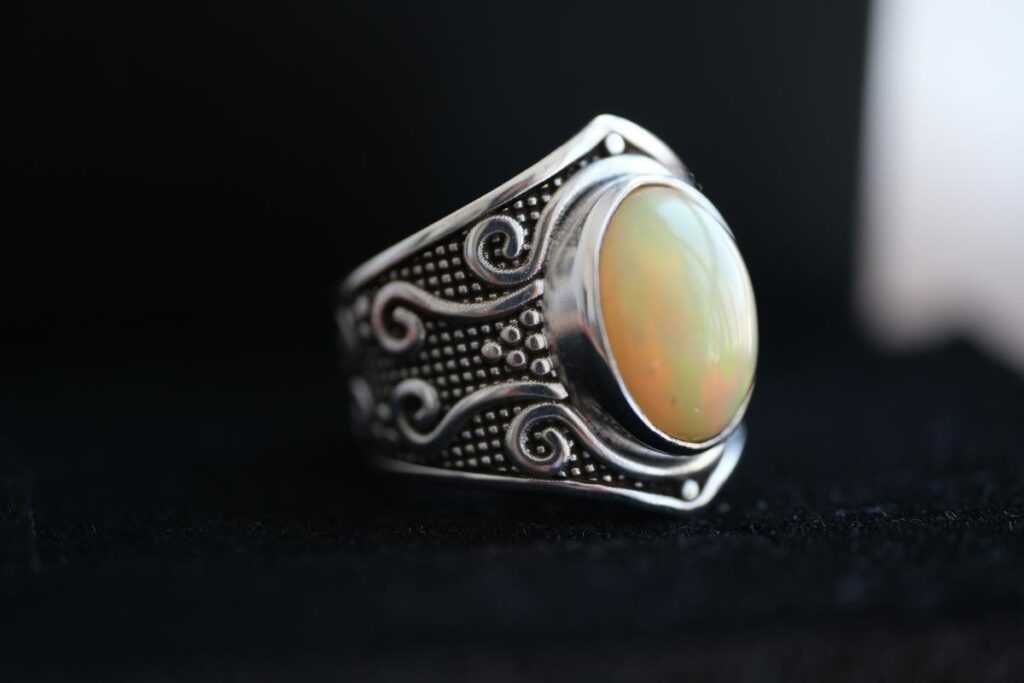
Camel and warm neutrals. Opal with warm undertones, stones with amber, honey, or peachy fire in them, sits beautifully alongside camel coats, warm grey knitwear, and terracotta tones. The warmth mirrors and complements.
Pairing Opal With Colour
The misconception about opal is that it clashes with colour. In practice, it layers with colour in ways that are more interesting than most single-stone alternatives.
The principle is to identify one of the colours within the opal and echo it in the outfit rather than trying to match the whole stone.
A blue-green opal pairs well with navy or teal. A white opal with pink and gold fire pairs naturally with blush tones and dusty rose. A fire opal with orange and red sits beautifully against emerald green for a complementary colour pairing that’s genuinely bold.
What doesn’t work is pairing opal with very busy printed fabrics that compete with the stone’s visual activity. Both are doing a lot at once and neither reads clearly. Keep prints simple if opal is the jewellery focus.
Ring Styling: Letting Opal Be the Statement
An opal ring works best when it’s allowed to be the statement piece on the hand. This means:
- Pairing it with simpler bands or keeping the other rings minimal
- Avoiding heavily textured or patterned sleeves that compete with the ring visually
- Choosing metal settings that complement your skin tone and the stone’s base colour
Yellow gold settings with opal are traditionally beautiful and work particularly well with warm skin tones and warm colour palettes. White gold and platinum settings create a cooler, more contemporary pairing that suits cool skin tones and neutral or cool-toned outfits.
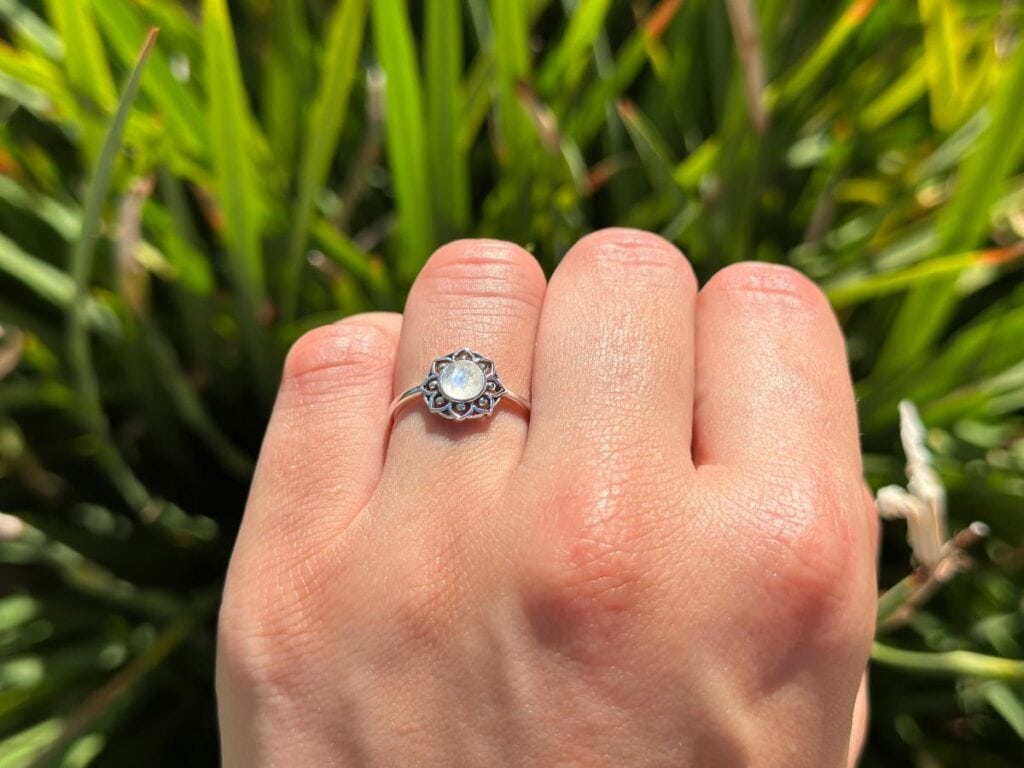
For everyday wear, a smaller opal ring in a low bezel setting sits comfortably and catches light in a way that creates consistent small moments of pleasure throughout the day.
Necklace Styling: Layer or Standalone
Opal necklaces offer two strong styling approaches: standalone statement and layered companion.
As a standalone piece, a larger opal pendant on a fine chain dresses up a simple outfit immediately. It works in situations where you want one intentional piece of jewellery and nothing else. This approach suits minimalist dressers and works well in professional settings.
In a layered approach, opal sits well as the colour anchor among simpler chains. The opal carries the visual interest while the surrounding chains add length variation and movement without competing. Keep the other chains simple and avoid stones that have their own strong colour or visual character.
For both approaches, the setting and stone quality significantly affect the result. Well-cut opal in settings that allow light to reach the stone from multiple angles catches light in movement in a way that photographs poorly but looks extraordinary in person.
Exploring the opal jewelry collection at Le Serey gives a clear sense of how setting and scale affect the styling potential of opal pieces. They have developed a collection that emphasises the stone’s natural character through thoughtful, clean settings, which is the design philosophy that produces pieces with genuine styling versatility rather than ones that work only in specific contexts.
According to the Gemological Institute of America’s opal grading overview, the brightness and pattern of a stone’s play-of-colour are the primary value factors, with stones that show colour from multiple viewing angles having the greatest visual presence and styling versatility.
Occasion Dressing With Opal
Casual daytime. A small opal stud or simple opal ring with jeans and a quality tee is an effortlessly elevated combination. The stone adds something without changing the casual character of the outfit.
Work and smart casual. An opal necklace or ring in a simple setting reads as intentional and polished without being overtly formal. It works in most professional environments and communicates considered taste without being distracting.
Evening and events. This is where opal truly earns its status. Against silk, velvet, or formal fabrics, the play-of-colour becomes more visible and more dramatic. A larger opal piece for evening creates the kind of impact that doesn’t need supporting jewellery.
Conclusion
Styling opal is less about following rules and more about understanding the stone’s visual character well enough to work with it intentionally. Its variability is a feature rather than a complication once you see it that way.
The stone that contains multiple colours simultaneously is also the stone that works with more outfits than almost any single-coloured gem. Once you start seeing it through that lens, the styling possibilities are considerably broader than you’d expect.