
A comfortable home is the foundation of family life. Whether you are managing winter heating bills, summer cooling demands, or just trying to keep the kids breathing easy through allergy season, your heating, ventilation, and air conditioning system shapes daily comfort more than almost any other home feature.

Alt text: A cozy family living room with comfortable seating and warm lighting
Local providers like Handy Bros. have served families across Ontario for over six decades, and their experience points to one truth: the families who get the most from their HVAC systems treat them as part of regular home maintenance, not as something to fix only when they break down.
What Are the Most Common Family Home Comfort Problems?
Most family comfort issues come down to a handful of recurring problems. Here is what shows up most often in home comfort calls.
Uneven temperatures between rooms top the list. The bedroom upstairs is freezing, the basement playroom is sweltering, and the main floor is somehow both. This usually points to ductwork imbalances, blocked vents, or an undersized system trying to do more than it can handle.
Air quality complaints come second. Dust accumulating faster than you can clean it. Allergy symptoms that get worse indoors. Stale air that lingers after cooking. According to the U.S. Environmental Protection Agency, indoor air can be two to five times more polluted than outdoor air, especially in newer homes that are tightly sealed for energy efficiency.
Energy bills that climb every year are the third common pain point. Aging equipment loses efficiency. Filters get clogged. Duct leaks send conditioned air into the attic instead of the living room. Each issue compounds the next.
How Should Families Approach HVAC Maintenance?
Regular maintenance is what separates families who replace their systems every 10 years from those who get 20 productive years from the same equipment. Here is a practical schedule.
- Replace filters every one to three months, depending on filter type, household pets, and seasonal allergens.
- Schedule a professional tune-up in spring (for cooling) and fall (for heating). A trained technician catches small issues before they become weekend emergencies.
- Keep outdoor units clear of leaves, grass clippings, and snow drifts. Two feet of clearance on all sides keeps airflow strong.
- Vacuum supply and return vents quarterly. Move furniture that blocks airflow.
- Check your thermostat batteries twice a year (when you change smoke detector batteries works perfectly).
- Listen for new noises: rattles, squeaks, or grinding sounds usually mean a part is wearing out.
A consistent maintenance routine costs far less than emergency repairs and adds years to your equipment life.
What Energy-Saving Habits Make the Biggest Difference?
Small habits add up to meaningful savings on your annual energy bill. According to Natural Resources Canada, heating and cooling account for about 60 percent of the average Canadian home’s energy use, so HVAC habits matter most.
- Programmable thermostat: Set the temperature to drop by a few degrees overnight in winter and rise during the day in summer when the house is empty. Modern programmable models save 10 to 15 percent on annual energy costs.
- Ceiling fans: Run them counter-clockwise in summer to push cool air down, clockwise in winter to circulate warm air. Both directions reduce HVAC load.
- Window treatments: Close blinds during the hottest part of summer days, open them on sunny winter mornings to capture solar heat.
- Door and window seals: Check weather stripping every fall. A small gap around a front door can leak as much air as a small open window.
- Vent management: Keep all vents open even in unused rooms. Closing vents creates pressure imbalances that strain the system.
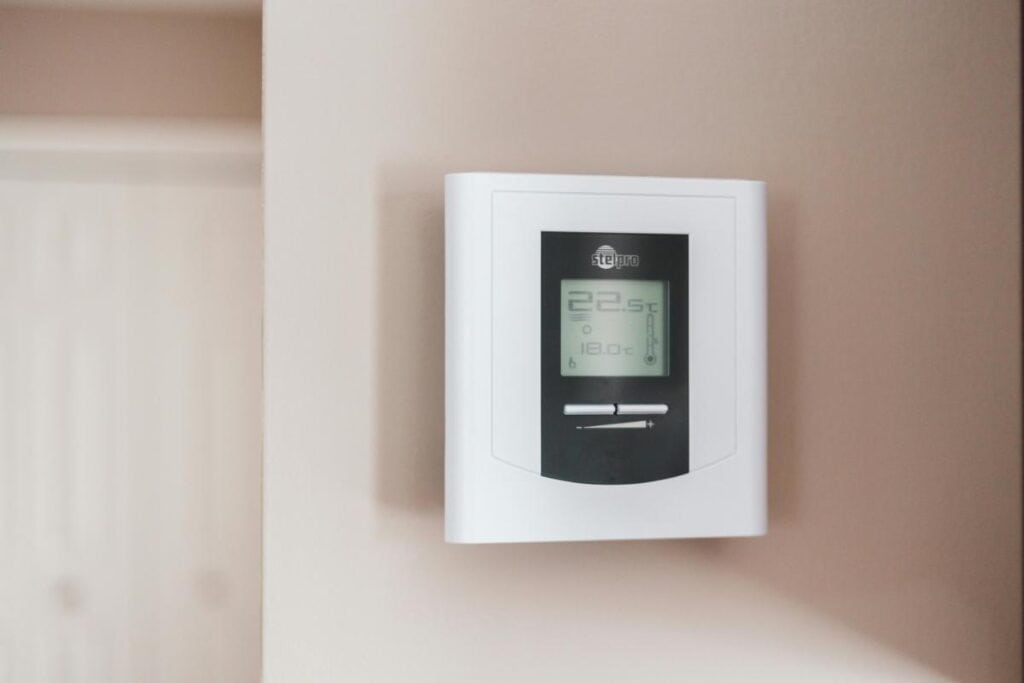
Photo by Erik Mclean on Pexels
Alt text: A modern programmable thermostat being adjusted on a home wall
These habits cost nothing to adopt and start saving money the same month you implement them.
How Do You Know When It Is Time to Upgrade?
Older HVAC systems eventually reach a point where repair costs exceed replacement value. Several signals indicate that time has arrived.
Equipment older than 15 to 20 years has typically lost significant efficiency, even if it still runs. Modern systems use 20 to 40 percent less energy for the same comfort output. Repair bills that climb past half the cost of a new system rarely make financial sense to absorb. Frequent breakdowns, especially during peak heating or cooling season, suggest the system is no longer reliable.
Rising humidity issues can also point to aging equipment. A correctly sized modern system manages humidity as well as temperature. If your home feels muggy in summer despite the AC running constantly, the equipment may be undersized or worn.
Family Home Comfort Checklist
- Replace HVAC filters every one to three months based on household needs.
- Schedule professional tune-ups twice yearly, before heating and cooling seasons begin.
- Use a programmable thermostat to save 10 to 15 percent on annual energy bills.
- Address indoor air quality with regular ventilation, filtration, and humidity control.
- Watch for uneven temperatures, rising bills, and unusual noises as early warning signs.
- Plan for HVAC replacement when systems pass 15 to 20 years or repair costs exceed half the replacement price.
Comfort That Works Around Your Family
Your HVAC system runs in the background of family life, shaping every meal, every bedtime, and every weekend at home. Treating it as essential infrastructure rather than an appliance you forget about pays off in lower bills, fewer emergencies, and a home that genuinely feels comfortable for everyone in it.
FAQ
How often should I change my HVAC filter with kids and pets in the house?
Every one to two months is recommended for households with children or pets. Standard pleated filters trap more allergens than basic fiberglass ones, which makes filter quality as important as filter frequency.
Is it worth installing a programmable thermostat?
Yes. Programmable thermostats typically pay for themselves within the first year through reduced heating and cooling costs. Smart thermostats add features like remote control and learning algorithms that increase savings further.
What is the best temperature setting for energy efficiency?
Natural Resources Canada recommends 20 degrees Celsius (68 F) when home in winter and 25 degrees Celsius (78 F) in summer when home. Adjusting by 2 to 3 degrees while away or asleep delivers the largest savings.
How long should an HVAC system last?
Furnaces typically last 15 to 20 years and air conditioners 12 to 15 years with regular maintenance. Heat pumps fall in the middle. Quality of installation, climate, and maintenance habits all affect actual lifespan.