
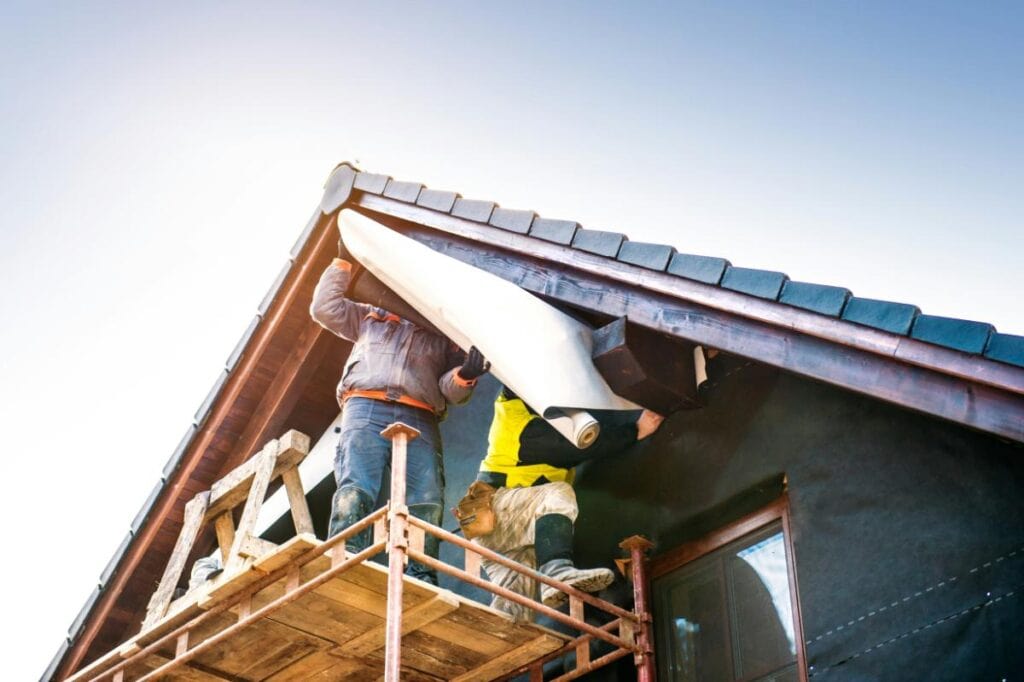
Repairing a leaky roof is a three-stage job. First, contain the water and protect the interior underneath it. Second, find the actual entry point. Third, match the repair to whichever component failed, whether that’s a shingle, a length of step flashing, a pipe boot, a valley, a skylight or a membrane seam. This guide is written for a homeowner dealing with an active or recurring roof leak on a typical asphalt-shingle house. Tile, slate, metal and flat membrane roofs need material-specific repairs and shouldn’t be treated the same way.
One idea underpins everything that follows: the ceiling stain is almost never directly beneath the hole. Water runs along decking, rafters and underlayment, sometimes dropping inside the walls instead, before it ever shows on a ceiling. Diagnose before you seal.
What should you do in the first five minutes of a roof leak?
- Move furniture, rugs and electronics clear of the drip to limit interior water damage.
- Catch or redirect the water into containers, or run it onto plastic sheeting.
- Stay out from under a bulging ceiling. Relieving a water-filled bulge is sometimes advised, but only from a safe position off to one side.
- Never touch a wet light fixture or wiring. Ready.gov advises switching power off at the panel only if you can reach it without standing in water.
- Photograph the stain, the attic and any storm damage outside. It’s a good idea to do that before you clean up.
- Start drying straight away.
That last step is time-sensitive. The EPA recommends drying water-damaged materials and belongings within 24 to 48 hours to limit mold growth. Fans, open cavities and a dehumidifier do more in that window than anything you can do on the roof, and insulation sitting above interior walls dries far slower than the surface suggests.
Is it safe to do roof leak repairs yourself?
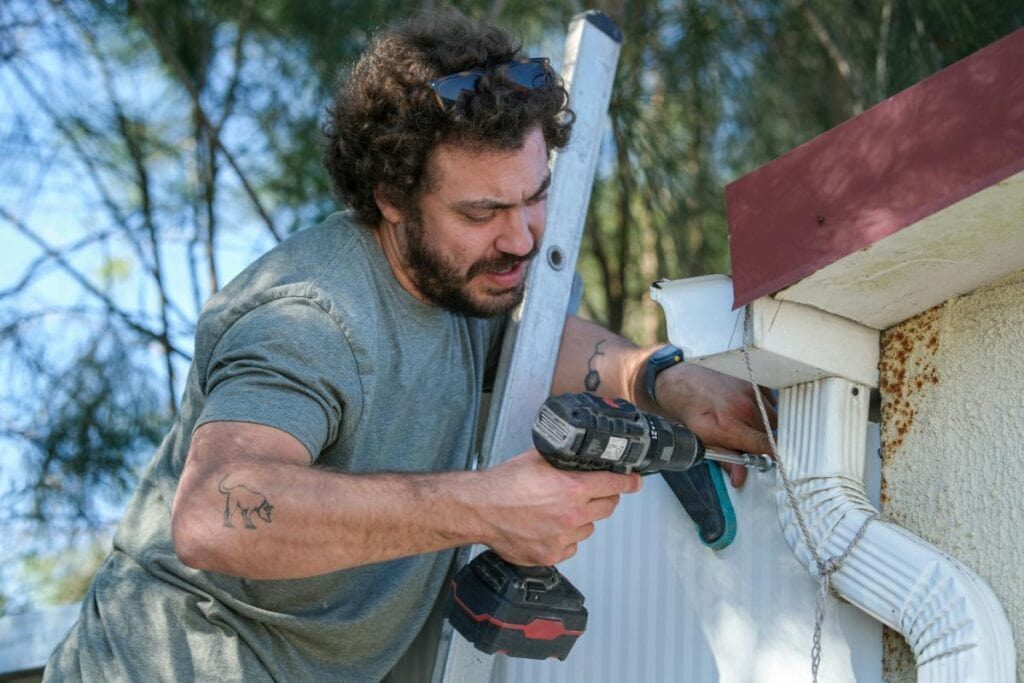
For most people the honest answer is to inspect from the ground and from inside the attic, then leave the roof surface alone. NRCA’s guidance is blunt: improper repairs damage roofs, and falls cause serious injury. Observing a defect and fixing one are different jobs.
Don’t go up at all if any of these apply:
- Rain, frost, wind, or a wet or mossy surface
- A steep pitch or a two-storey house
- Tile, slate or old brittle shingles
- Soft, spongy or sagging decking
- Service lines near the ladder
- No helper, no proper ladder, no fall protection
On ladders, CDC/NIOSH reports that an incorrect setup angle contributes to roughly 40% of incidents where an extension ladder’s base slides out. Set it near 75 degrees, extend it well past the roof edge, and keep three points of contact.
How do you locate a roof leak?
- Note when it leaks. A small leak that appears only in wind-driven rain usually points to a vertical detail rather than the open field of the roof.
- Go into the attic with a flashlight. Look for wet insulation, darkened decking, rusted nails, mold and daylight.
- Trace the staining upslope to the highest wet point you can find.
- Map that point to what sits above it outside: vents, pipe boots, valleys, the chimney, a skylight, a wall intersection.
- Scan from the ground with binoculars after severe weather, looking for missing or lifted shingles.
- Controlled hose testing in small sections, low to high, with a helper watching the interior. Treat this as a professional step.
NRCA notes that repairs commonly fail because nobody verified the leakage path first, so penetrations and flashings deserve attention early.
Is it actually a roof leak?
Plenty of ceiling stains never came through the roof covering. Plumbing leaks, HVAC condensate, a bath fan venting into the attic, skylight condensation, water tracking in around windows or down an exterior wall, and ice dams all imitate one. Rough screening: rain only suggests exterior entry, snowmelt suggests ice dams, stains after showers or laundry suggest condensation, and droplets on nail tips across the whole attic point to an attic moisture problem rather than a hole. The Department of Energy treats these as separate moisture routes for good reason.
Common roof leak sources and what lasting repairs involve
Identify the roof material first, because that decides the method. Then match the symptom to the failed component.
| What you see | Where to inspect | What lasting repairs involve |
| Stain under a plumbing vent | Rubber boot, flashing, nearby nails | Replace the boot assembly, not another bead of caulk |
| Leak where a wall or dormer meets the roof | Step flashing, siding, corner trim | Rebuild the overlapping flashing sequence with each shingle course |
| Leak near the chimney | Counterflashing, masonry, cricket | Targeted flashing repairs |
| Leak after snowmelt | Eaves, gutters, insulation, ventilation | Fix the ice-dam mechanism, not the shingles |
| Droplets across the attic | Ventilation, air leakage, exhaust ducts | Moisture-control repairs |
| Repeat leak after sealing | Hidden flashing or underlayment | Investigate and rebuild |
| Sagging or soft deck | Decking and framing | Structural assessment |
Missing, cracked or lifted shingles and old fastener holes
Replace the damaged shingle and nail within the manufacturer’s nailing area. Smearing roof sealant over a cracked tab is a stopgap at best, since the sealant hides the defect instead of correcting it. For a small hole left by a removed antenna mount, liquid flashing outlasts ordinary caulk. Once you start removing shingles to reach a flashing detail, the courses above have to be unsealed and re-nailed correctly, which is why ARMA holds that asphalt roofs are repairable component by component but that qualified roofers should handle the repairs. The 2024 IRC (R904.1 and R905.2.8) requires assemblies and flashing to follow the code and the manufacturer’s instructions, with sidewall flashing discharging onto the roof or into a gutter.
Valleys, skylights and low-slope roofs
Valleys carry concentrated runoff and leak from bad shingle cuts, corroded metal, trapped debris or failed underlayment, so keep them and the gutters clear. A skylight leak may come from the unit, the flashing kit, the surrounding roofing, the curb, or condensation, so check all of them. On EPDM, TPO, PVC or modified bitumen, the patch must be compatible with the membrane. Generic roof cement on an unidentified membrane is never the right solution.
Temporary roof leak fixes versus permanent repairs
A tarp or emergency patch buys time. It does not repair failed flashing, soaked underlayment or rotten decking, and FEMA and ARMA are clear that these are short-term measures pending real repairs.
- Never tarp in wind, rain or ice.
- Fasten the cover so it can’t blow free, and run it over the ridge where you can.
- Sealing from the attic side sounds like a sensible idea, but it won’t stop water entering the assembly above.
- Don’t cover wet or rotten material without investigating it first.
- Check the cover after every storm until permanent repairs are booked.
- Verify the finished work in the next rainfall or with a controlled hose test.
- Don’t patch ceiling drywall until the roof leak is fixed and everything is dry.
When is a roof leak not a safe DIY home improvement project?
Hand it over for a steep or high roof, sagging decking, a storm opening from a branch or hail, a leak that returned after a previous patch, chimney or valley or skylight flashing, tile and slate and metal and membrane systems, or any job that means pulling siding or several courses of shingles. Northern California homeowners can include Cobex Construction Group in a broader comparison of local exterior home improvement firms, credentials and written scopes.
Roof leak repairs or a new roof?
Simple shingle or boot repairs often run a few hundred dollars. Replacing the entire roof commonly lands around $22,636 to $38,600, and a new roof can add roughly 5% to home value. Most roofs last 15 to 40 years, with three-tab shingles closer to 12 to 15 and architectural shingles around 25 to 30.
Repairs make sense when the defect is isolated and identified, the surrounding roof is still in good shape, the decking is sound, and the work can be integrated with existing flashing and underlayment.
A new roof deserves a hard look when leaks recur in several places, shingles are widely deteriorated, decking is soft, insulation is extensively wet, or earlier repairs have already failed. NRCA makes the point that one leak doesn’t condemn a roof, so drop the idea that a single stain means replacement, and skip age-only rules.
What should you ask before authorizing roof repairs?
- Where exactly is the entry point, and what evidence supports that?
- Are these repairs temporary or permanent?
- Will shingles, flashing, underlayment or decking be removed?
- Are the materials compatible with the existing roof?
- Does the price cover wet decking if it’s found?
- Who pulls permits, and what warranties apply to labor and materials?
- Is the contractor licensed and insured? The FTC advises multiple written estimates and a contract naming materials, price and timing.
If you have no idea where the water is entering, a proper inspection beats repeated sealing. Bay Area property owners can compare Symplify Roofing with other licensed local roofers on diagnosis, scope, materials and warranty terms. NAIC is clear that homeowners insurance isn’t a maintenance contract: sudden storm damage may be covered, gradual wear generally isn’t. Photograph everything and call your insurer before discarding damaged material.
Frequently asked questions about fixing a leaky roof
Can I fix a leaking roof myself? Sometimes, if the damage is minor and safely reachable, such as a single cracked shingle on a low-pitch roof. Flashing, valleys, decking and any roof you can’t stand on safely belong with a professional.
How much do roof leak repairs cost? A straightforward shingle or vent boot repair is usually a few hundred dollars, while full replacement runs about $22,636 to $38,600. That gap is why diagnosis should come before any quote.
What is the best solution for a leaking roof? A verified diagnosis, then replacement of the component that actually failed. Sealant over a flashing problem is the most common reason a roof leak returns, and fixing a small leak early costs far less than repairing the water damage it spreads through the house.
How do you stop a leaking roof during heavy rain? You generally don’t carry out repairs in the rain. Contain the water, protect belongings, arrange professional tarping once conditions are safe, and schedule permanent repairs for dry weather.